Time series foundation model

Real-world data. Better decisions.

Irregular observations, missing values, and high-frequency signals. One time-series platform for forecasting, anomaly detection, and imputation.

Trials are by invitation.

yoft-oTime-series orchestration
Illustration · Sample data
01Benchmark results

Performance. In the open.

Meet yoft-o, yoft’s orchestration model. It combines time-series models to deliver accurate forecasts without task-specific fine-tuning.

GIFT-EVAL / 2026-09-14

yoft-o

The orchestration model behind yoft

No fine-tuning · no LLM‡

The lowest normalized MASE among forecasting methods that use neither dataset-specific fine-tuning nor LLMs, based on the published GIFT-Eval results.

Among methods without fine-tuning or LLMs
1st‡

#3 overall, without these conditions†

Point forecast error
0.650MASE ↓
Probabilistic forecast error
0.444CRPS ↓
Entries in the full benchmark
129entries

‡ Our ranking by normalized MASE uses the public results retrieved on 2026-09-14. “No fine-tuning” means no dataset-specific training of model weights. “No LLM” means no LLM in the forecasting pipeline, including retrieval selection. EXAONE-Forecast-Agent and STRIDE w/ Synapse, the two higher-scoring entries, are excluded because their primary sources document LLM use in forecasting. Under these conditions, yoft-o (listed as TIMEHEDGE) ranks first. This is not an official leaderboard category. The assistant for explaining results and conversation is a separate feature.

† Based on 129 GIFT-Eval entries retrieved on 2026-09-14, ranked by normalized MASE. This differs from the leaderboard’s default ordering. Lower MASE and CRPS are better.

These results evaluate the model used for regularly sampled forecasts. Performance on public datasets does not guarantee accuracy on your data.
02Why yoft

Beyond forecasting. Built for the real world.

yoft handles forecasting and, beyond it, the whole path from field data to a decision, on one foundation.

Point 1Custom implementation

Explainability

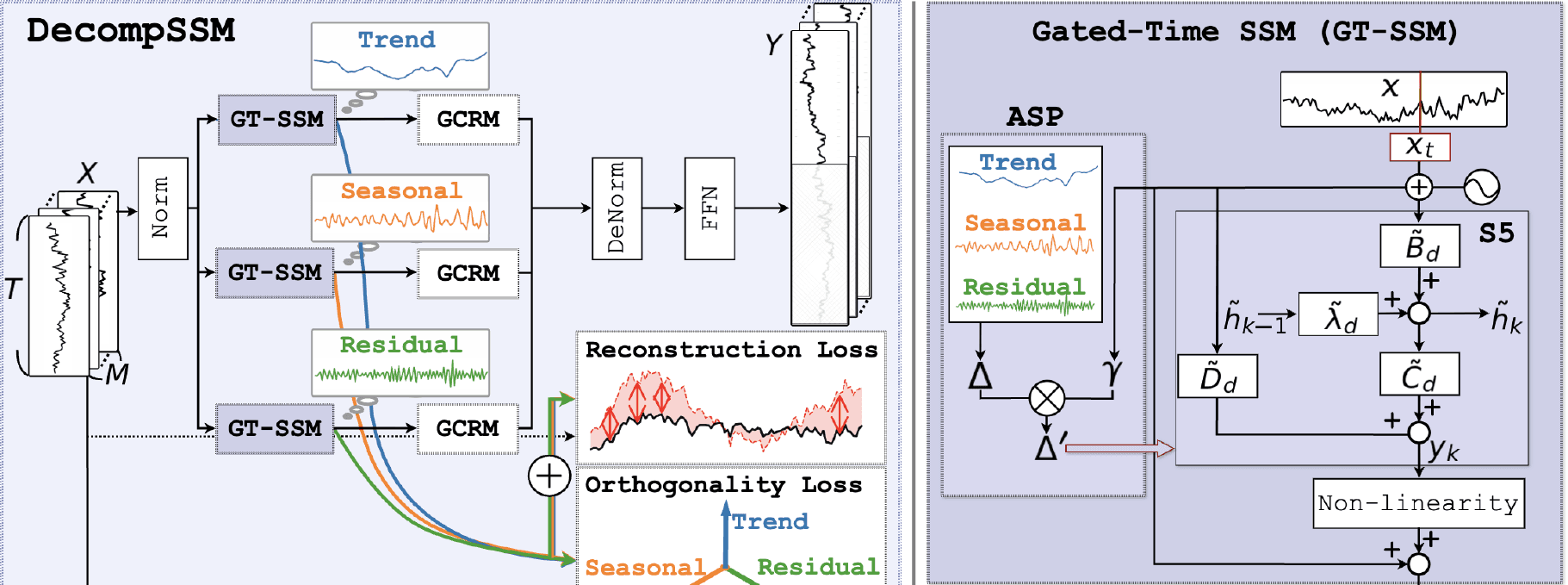
Break forecasts into trends, seasonal patterns and residuals to examine the reasoning behind a prediction. We can integrate DecompSSM through a custom implementation tailored to your data and workflows. Component breakdowns are not included in standard API responses.

Point 2

Field data

Irregular intervals, missing values, and high-frequency signals. Designed to work with data before it has been cleaned and reshaped.

Point 3

Multiple tasks

Forecast, detect anomalies, fill gaps and obtain embeddings for similarity search or classification. Classifiers and label decisions are implemented by the caller.

  • Forecasting
  • Anomaly detection
  • Embeddings
  • Imputation
CAPABILITIES

Versus existing models

From forecasts to analysis and explanation, combine our standard APIs with custom implementations for your workflows.

Coverage of major public foundation models and yoft
ItemMajor public foundation modelsPrimarily focused on forecastingyoftStandard APIs and custom implementations
Forecastingsupportedsupported
Probabilistic forecasts (ranges)supportedsupported
Covariatessupportedsupported
Irregular spacing and imputationpartly supportedsupported
Signal waveformsOutside core scopesupported
Anomaly detectionOutside core scopesupported
Embeddings for search / classificationOutside core scopesupported
ExplainabilityOutside core scopeCustom implementation

Public-model coverage is a general tendency, not an exhaustive survey. The yoft API returns embeddings; callers implement their own classifiers. Component-based explanations are available through custom implementation, separately from the standard API.

03Features

Data as it was recorded, before any cleaning.

Intervals vary, values go missing, and high-frequency waveforms are mixed in. yoft takes such field data as input without rounding it.

01

Irregular spacing

Fig. 1a — Forecasting directly from unevenly spaced observations (ticks). The marks below are observation times

Pass the observation times as they are. There is no resampling to a grid; the spacing itself carries information.

02

Missing values

Fig. 1b — Estimates and forecast range for a missing interval (hatched)

Gaps stay gaps. When you need values, yoft returns estimates with a forecast range.

03

High-frequency waveforms

Fig. 1c — A waveform as input, with one abnormal beat (vermilion) detected

ECGs and vibration are the same kind of input. yoft reads the cycle without breaking it and finds the beat that does not fit.

Illustrative signals demonstrate the processing flow; they are not measured data or an accuracy evaluation.

04Research

Research, put to work.

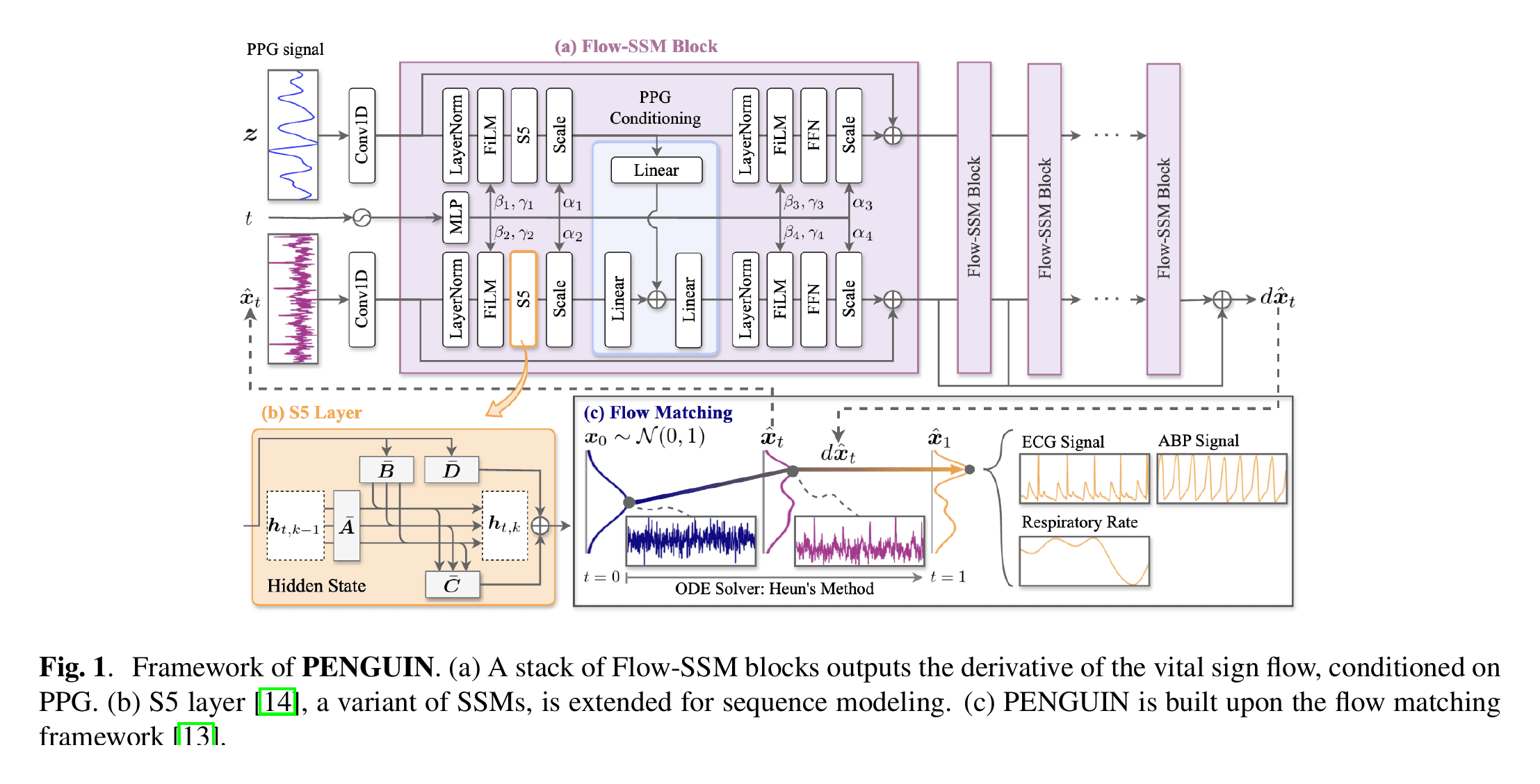
Time-series forecasting and signal reconstruction research accepted at ICASSP 2026, the world's top international conference in signal processing. These technologies are available through custom implementations tailored to your data and workflows.

ICASSP 2026 · oral presentation01

DecompSSM

Multivariate forecasting
DecompSSM architecture: three GT-SSM branches for trend, seasonal and residual components with GCRM, reconstruction and orthogonality losses, and input-dependent timescale adaptation.
Forecasting through three component-wise branches

A forecasting study with separate state-space branches for trends, seasonal patterns and residuals. Shared multivariate context helps examine how each component behaves.

Learn more
ICASSP 202602

PENGUIN

Signal reconstruction
PENGUIN architecture: PPG-conditioned Flow-SSM blocks, S5 layers and flow matching from noise to ECG, blood-pressure and respiratory waveforms.
Reconstructing vital sign waveforms from PPG

Research into reconstructing vital signs from photoplethysmography (PPG), combining flow matching with a state-space model.

Learn more

Researchers published at world-leading conferences in AI, signal processing and computer vision.

ICASSPICCVAAAI

Our team brings research in computer vision, AI and signal processing into practice. Members have also won a CVPR competition and worked on joint research and technical advisory projects with national university hospitals and major companies.

05API

Turn past data into future forecasts.

Send your past numerical data and how many future points you want to predict. Receive forecasts and prediction ranges to use in your service, with no model selection or fine-tuning setup.

Request · curl
curl -X POST "$YOFT_API_BASE/v1/forecast" \
  -H "Authorization: Bearer $YOFT_API_KEY" \
  -H "Content-Type: application/json" \
  -d '{
    "series": [{ "name": "load", "values": [412.0, 398.5, 401.2, "…", 455.8] }],
    "horizon": 24,
    "quantiles": [0.1, 0.5, 0.9]
  }'
Response · 200
{
  "request_id": "req_a1b2c3d4e5f67890a1b2c3d4e5f67890",
  "model": "yoft",
  "model_version": "v1",
  "forecast": [{
    "name": "load",
    "values":    [458.1, 462.7, "…"],
    "quantiles": {
      "0.1": [441.3, 443.9, "…"],
      "0.5": [458.1, 462.7, "…"],
      "0.9": [474.8, 481.2, "…"]
    }
  }],
  "usage": { "input_points": 168, "output_points": 24, "series_count": 1 }
}
Endpoints
POST/v1/forecastForecasting with multivariate, covariate, quantile and irregular-timestamp support
POST/v1/anomalyPer-step anomaly scores (distributional surprise and forecast error)
POST/v1/imputeEstimates and quantiles at missing positions
POST/v1/embedFixed-length vectors for similarity search and classification
GET/v1/modelsList the models available to your key

up to 64 series per request16–2048 points per serieshorizon up to 512quantiles at no extra charge

Time-series data sent to the API is never used to train or fine-tune models. Raw time-series values are not stored or logged.

Read the API documentation — no sign-in required

Invited accounts can try 16 use cases and their own CSV in the Playground. Result aggregates and chat content are sent to an LLM only when using the AI assistant in the Playground. When the assistant is enabled, aggregates are temporarily stored with a 24-hour expiry. Sign in

06Industries

Forecasts change decisions across industries.

Deployed across a wide range of industries: anywhere a number moves with time.

01

Healthcare

  • Onset prediction
  • Deterioration risk
  • Vital-sign forecasting
  • Bed demand
  • Biosignal anomaly detection
02

Retail & e-commerce

  • Sales forecasting
  • Product demand
  • Inventory optimization
  • Store traffic
  • Input price forecasting
03

Power & energy

  • Load forecasting
  • Generation forecasting
  • Market price forecasting
  • Equipment failure
  • Battery scheduling
04

Finance

  • Market prices
  • Funding demand
  • Credit risk
  • Cash-flow forecasting
  • Fraud and anomaly detection
05

Manufacturing

  • Production demand
  • Material prices
  • Equipment failure
  • Quality anomalies
  • Production and inventory planning
06

Disaster & environment

  • Rainfall and flooding
  • Network outages
  • Solar flares and space weather
  • Epidemic spread
  • Road, bridge and pipe degradation
07

Logistics

  • Logistics demand
  • Freight volume
  • Delivery delays
  • Fleet dispatch
  • Warehouse utilization
08

Agriculture

  • Yield forecasting
  • Growth and quality
  • Disease outbreaks
  • Crop prices
  • Heat and drought damage
07FAQ

Questions

Is my data used for training?

Time-series data sent to the API is never used to train or fine-tune models. Raw time-series values are not stored or logged and are discarded after analysis.

Can I send irregularly spaced data or data with gaps as it is?

Yes. Attach timestamps and the series is forecast without resampling. Missing values themselves can be reconstructed with /v1/impute, as estimates with a forecast range.

Does the forecast use an LLM?

Numerical forecasts use time-series models, not an LLM. Result aggregates and chat content are sent to an LLM only when you use the AI assistant in the Playground. Raw time-series arrays are not automatically attached from the results. Anything you enter in the chat is sent and may be processed outside Japan.

Which model is running?

yoft-o, yoft’s orchestration model. It combines models developed in Japan with public time-series foundation models. The internal composition evolves while the API contract stays stable.

Is accuracy guaranteed?

No. Use the public benchmark results and a check on your own data as the basis for a decision. We run such checks on request.

Can it run on-premises or at the edge?

Ask us. The API is the default, but other forms of delivery are considered case by case.

08Contact

Tell us the shape of your data.

How many series, how they are spaced, how much is missing. With that, an engineer will tell you whether yoft is a fit.